
Why does a tight month feel so heavy?
- Rent, food and bills have climbed faster than pay for many young adults, so a stretched month is a shared, structural squeeze, not a personal failing.
- Scarcity studies suggest money worry can crowd the mind and narrow focus onto the most urgent bill, though later replication work found the evidence mixed.
- Small, free things still count: one calm look at the numbers, a walk or a library card, a meal cooked with a friend, and saying the worry out loud to someone.
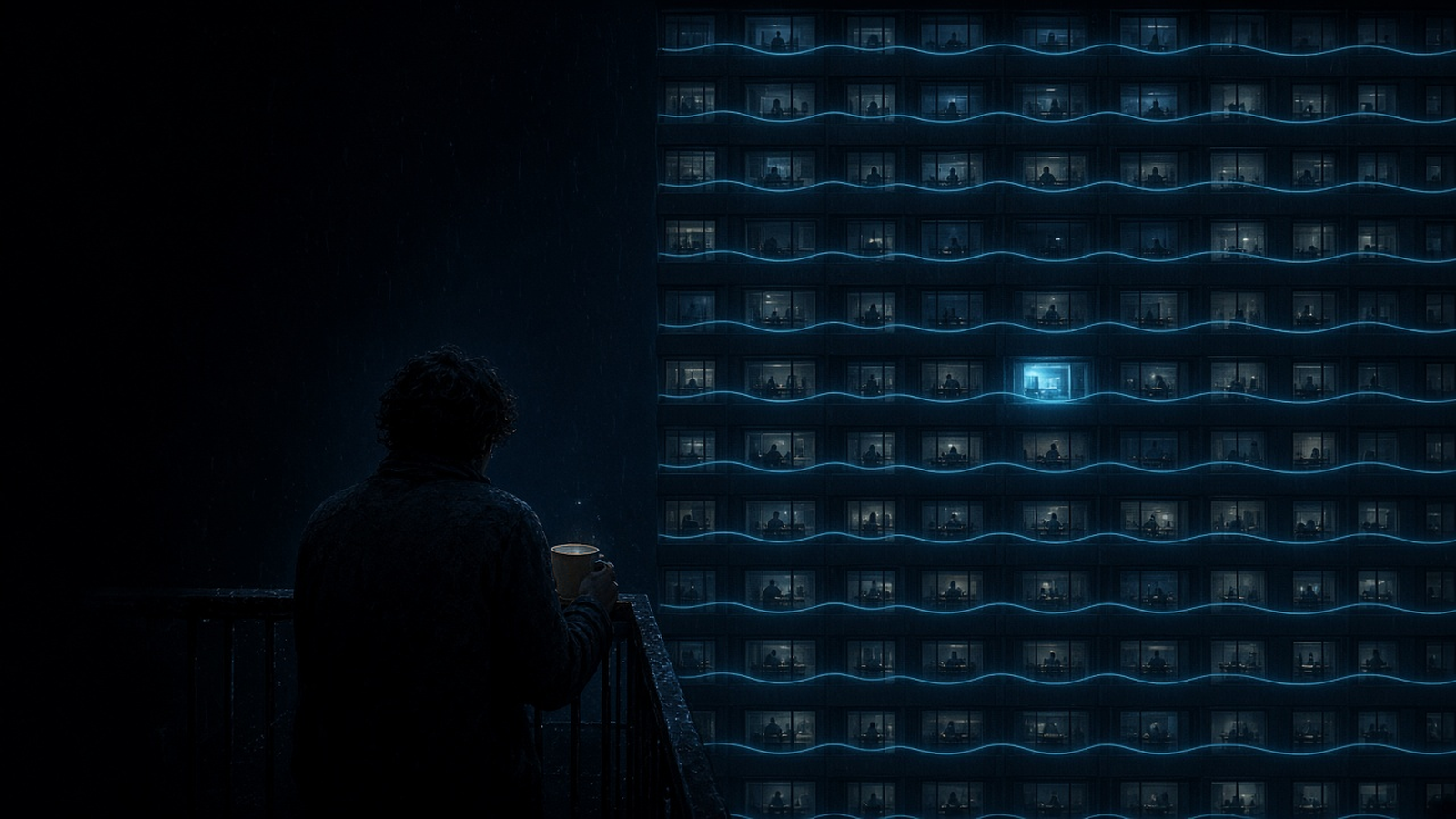
A tight month is not heavy mainly because of the money. Most of the weight comes from the attention it quietly takes, all day long, even when no bill is in front of you.
That sounds like a strange claim, since the money is the problem. But the shortfall itself is a number, and numbers sit still. What moves around, and follows you onto the bus and into the shower and into the minutes before sleep, is the part of the mind that keeps checking whether the number will hold. This post looks at that part in layers: what may be happening in attention, what the studies found, where those studies fall short, and what any of it means on an ordinary Tuesday.
First, the plain context. For a lot of young adults, rent, food and bills have risen faster than pay. Living from one payday to the next is common, not rare. When something is that widespread, it is a feature of the times, not a flaw in the person carrying it.
Money worry competes for the same attention as everything else
Attention is limited. You can only hold so much in mind at once, and anything that keeps tugging at it leaves less for the rest.
A stretched month tugs constantly. There is the date rent leaves the account, the gap before the next deposit, the subscription you forgot about, the friend’s birthday dinner you are quietly pricing up. None of these needs to be solved right now. They still sit in the background, like a tap dripping in the next flat, and some share of you keeps listening for the next drop.
Researchers who study scarcity have a name for this pull. They call it a tax on bandwidth: the mental room left over for reasoning, planning and self-control after worry has taken its cut.
Studies from 2012 and 2013 point to a narrowed, crowded mind
The best-known work comes from a small group of economists and psychologists.
In 2013, Mani, Mullainathan, Shafir and Zhao asked shoppers in a New Jersey mall to think through a hypothetical car repair. For some, the repair was cheap. For others, it was expensive. When the cost was high, lower-income participants scored worse on tasks of reasoning and self-control. Higher-income participants did not show that drop. The same team looked at sugarcane farmers in India, whose income arrives in a lump at harvest. The farmers scored better on the same kind of tasks after harvest, when money had come in, than before it. The authors argued that money worries take up mental bandwidth.
A year earlier, Shah, Mullainathan and Shafir ran lab games in which some players were given scarce resources. Those players focused hard on the immediate problem. That made them efficient in the moment. It also made them more likely to borrow against the future and to neglect other things. The authors called this narrowing “the tunnel”.
Put together, the picture looks something like this:
| Layer | What tends to happen | What it can feel like |
|---|---|---|
| Background | Money worry keeps pulling at attention | Tired without a clear reason |
| Focus | Attention narrows on the most urgent gap | Sharp on one bill, foggy on the rest |
| Trade-off | Today wins over later | Choices that make next month tighter |
Later checks from 2016 and 2021 found the evidence mixed
Here is where the story needs care, because the neat version is not the whole one.
In 2016, Carvalho, Meier and Wang tested low-income survey participants in the United States before and after payday. On tests of cognitive function, they found no difference. What they did find was that people made more present-focused choices about money before payday. So the tunnel showed up in decisions, but the broader drop in thinking did not.
Then, in 2021, O’Donnell and colleagues published a large audit and replication effort covering scarcity research. The evidence turned out mixed. Replications were often weaker or less consistent than the original studies.
That does not mean the weight is imaginary. It means the science has not settled how much a tight month changes thinking, for whom, or under what conditions. The honest reading is narrower: worry about money can crowd attention and pull choices toward the short term, and the size of that effect is still argued over.
What it means on an ordinary day
If any version of the tunnel is real, two things follow, and neither involves blaming yourself.
The first is that feeling scattered in a short month is not proof that you are bad with money. It may simply be what a mind does when one problem keeps asking for the floor. Many people around you are carrying the same thing, often without saying so.
The second is that small moves which give attention somewhere else to rest are worth something, even when they do not change a single figure.
One calm look at the numbers. Not a budget overhaul. Just sitting down once, in daylight if you can, and writing what is coming in and what is going out. A vague dread tends to take up more space than a known quantity. Seeing it once can let the background checking slow down a little.
A free pleasure. A long walk while the streetlights come on. A library card, which still opens a whole building of books, films and warm seats at no cost. Cooking a cheap pot of something with a friend, where the evening is the point and the food is a bonus. These do not solve anything. They give the mind a few hours outside the tunnel.
Saying it out loud. Telling one person, “This month is tight and it is getting to me,” does something a spreadsheet cannot. It turns a private tally into a shared fact. Often the other person answers with their own version, and the weight sits differently once two people are holding it.
Some evenings will still feel heavy. Rain on the window, a slow breath, a quiet stretch with nothing asked of you: those moments do not change the balance either, and they do not have to. They are simply a pause between the checks. If you have a steady background you like to keep on while you read or wind down, moonMind is one place to find it, nothing more.
A short caveat
This post is not financial, legal or medical advice, and it does not recommend any product or plan. If money pressure is leaving you unable to cover essentials, or the worry is wearing you down for weeks, reach out to a local advice service, a doctor or someone you trust.
Sources
- Mani A, Mullainathan S, Shafir E, Zhao J. Poverty impedes cognitive function. Science, 2013. https://doi.org/10.1126/science.1238041
- Shah AK, Mullainathan S, Shafir E. Some consequences of having too little. Science, 2012. https://doi.org/10.1126/science.1222426
- Carvalho LS, Meier S, Wang SW. Poverty and economic decision-making: evidence from changes in financial resources at payday. American Economic Review, 2016. https://doi.org/10.1257/aer.20140481
- O’Donnell M, et al. Empirical audit and review and an assessment of evidentiary value in research on the psychological consequences of scarcity. PNAS, 2021. https://doi.org/10.1073/pnas.2103313118
This post is not financial, legal or medical advice, and it does not recommend any product or plan. If money pressure is leaving you unable to cover essentials, or the worry is wearing you down for weeks, reach out to a local advice service, a doctor or someone you trust.
A steady layer under the evening Mono white, pink or brown noise and a library of real recordings. Not medical, and not an answer to anything a bank statement says.
Open moonMind